Service, dignity and the individual
Military and Veteran Funeral Celebrant
A military or veteran funeral may include cherished traditions, precise ceremonial moments and powerful symbols of service. It is also a farewell to an individual — a person known and loved far beyond their uniform.
Contact me to discuss your requirementsUnderstanding formed through Royal Navy service
As a former Royal Navy officer, who also served with the Royal Marines, Army and Royal Air Force, I understand why service traditions can matter so deeply. They may represent shared experience, loyalty, sacrifice, professional pride and a lifelong sense of belonging. Small details — the correct sequence, a moment of stillness, the sound of a familiar piece of music or the presence of a standard — can carry considerable meaning.
My background also gives me an appreciation of timing, protocol and the need for calm coordination. I approach these ceremonies with respect and care, without allowing formality to overshadow the person whose life the family has gathered to honour.
Formal ceremony or selected military elements
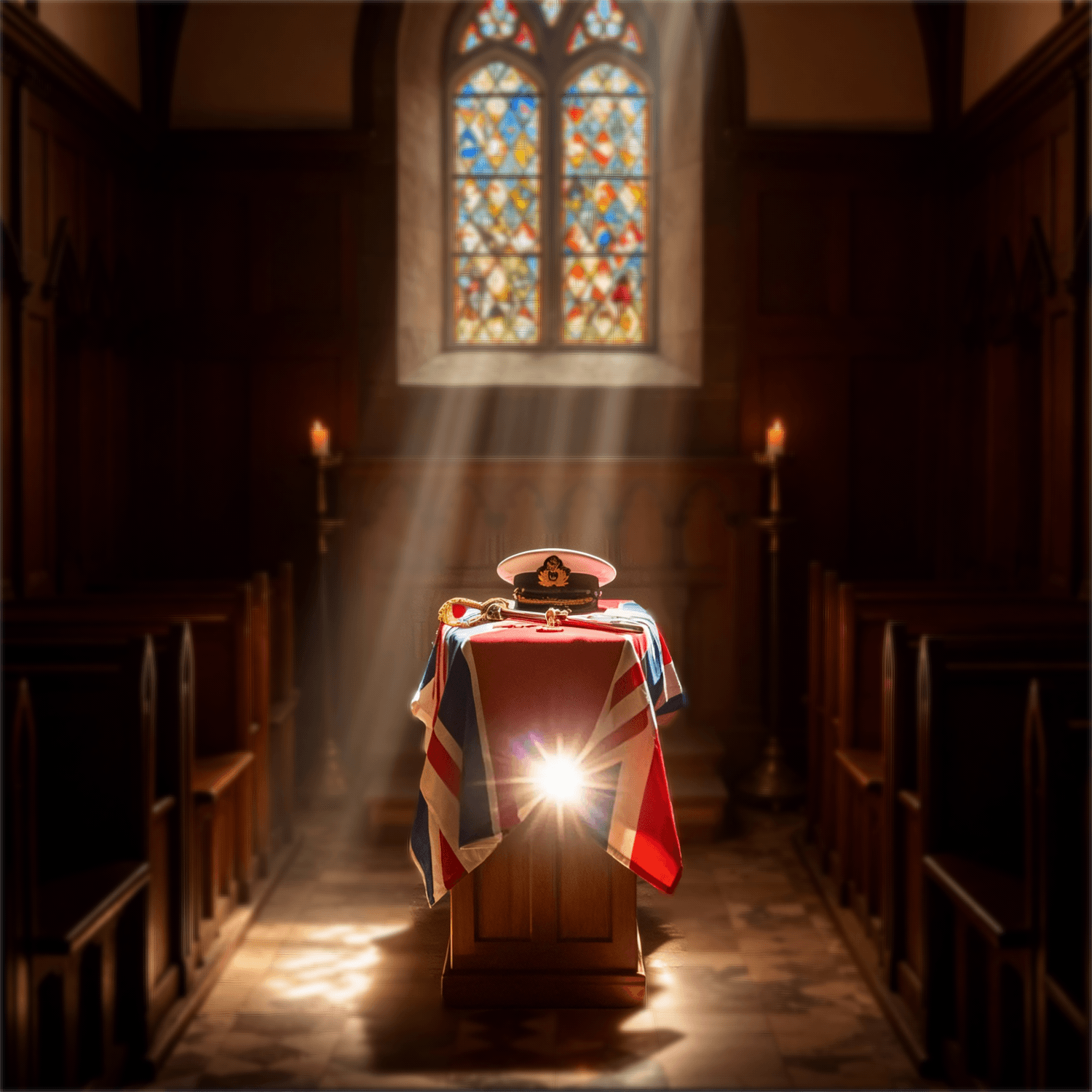
There is no requirement for every veteran’s funeral to take the same form. A family may wish to include a number of formal elements, carefully coordinated with the funeral director and other participants. Another family may prefer a quieter service in which military life is acknowledged through a hymn, reading, prayer, piece of music, moment of silence or a few carefully chosen words.
Appropriate naval or military elements can be woven into the ceremony where they are available and right for the family. Depending on what has been arranged by the relevant parties, this may involve veterans’ organisations, standard bearers, a bugler or serving representatives. I work sensitively with everyone taking part so that responsibilities, timing and the order of ceremony are clear.
I do not suggest that particular honours, personnel or ceremonial support can be guaranteed. These arrangements depend upon eligibility, availability and the organisations concerned. My role is to lead the ceremony and help agreed elements sit together with dignity and purpose.
The individual remains at the heart of the ceremony
A uniform may have been central to someone’s life, but it is not the only way they were known. They may have been a partner, parent, grandparent, colleague, friend or neighbour. They had interests, opinions, habits and stories which made them unmistakably themselves.
Our discovery meeting therefore considers the whole life. We talk about service and career, but also about family relationships, childhood, later years, humour, achievements and the ordinary moments people remember with affection. I use this to write a eulogy that gives military service its proper place while preserving a rounded and recognisable portrait.
The family can review the wording and contribute further memories before it is finalised. If a relative, friend or former colleague wishes to speak, I can help them prepare and ensure their contribution fits naturally within the service.
Working with all those involved
Military elements often involve more people than a conventional ceremony. Clear communication matters. I liaise with the funeral director and work respectfully with veterans’ organisations, standard bearers, buglers and serving representatives where these have been arranged.
Before the funeral, we agree the sequence, cues and responsibilities. On the day, I arrive early, check the order and help ensure that spoken words, music, silence and ceremonial actions form one composed farewell.
I support veterans of all services. A ceremony may be non-religious, Christian, spiritual or blended. The approach is always guided by the individual’s life and beliefs, the family’s wishes and the traditions that are genuinely meaningful to them.
Military and veteran funeral FAQs
Do you conduct funerals for veterans of every service?
Yes. My own background is in the Royal Navy, but I support veterans of the Army, Royal Air Force, Royal Marines and other services. The ceremony is shaped around the individual and the traditions relevant to their service.
Does a veteran’s funeral have to be fully ceremonial?
No. Some families want a formal service with several military elements; others choose only one or two quiet acknowledgements. Both approaches can be dignified and meaningful.
Can you arrange a bugler, standard bearer or serving personnel?
I do not promise or arrange honours, personnel or ceremonial support unless separately confirmed. I can work sensitively with the funeral director, veterans’ organisations, standard bearers, buglers or serving representatives arranged by the family or appropriate organisation.
Can religious and military elements be combined?
Yes. Prayers, hymns, blessings or other faith elements can sit alongside military traditions and a personal eulogy. We will agree a coherent order that reflects the person and the family’s wishes.
How do you keep the funeral personal?
The discovery meeting explores the whole life: family, friendships, work, interests, personality and memories, as well as service. Military identity is treated as an important part of the story, not the whole of it.
Contact me to discuss your requirements
If it would help to talk things through, you are welcome to call or email me for an initial, no-obligation conversation.