Time and space to remember
Memorial Services and Celebrations of Life
A memorial service or celebration of life offers family and friends a shared occasion to remember, reflect and say farewell. It can follow a direct cremation, take place when more people are able to attend, or mark an anniversary or the laying of ashes.
Contact me to discuss your requirementsFuneral, memorial service or celebration of life?
A funeral is normally held soon after someone dies and is connected with their cremation or burial. The coffin is present, practical timings are often fixed and the ceremony forms part of the funeral director’s arrangements.
A memorial service is held without the coffin and may take place days, weeks or months later. A celebration of life is also a memorial occasion, often with a stronger emphasis on memories and personality. It can be as formal or informal as you wish, its tone can be warm, reflective, traditional, gently uplifting or uproariously funny. In fact, whatever you wish.
The most useful distinction is not the name, but what the gathering needs to do. I help you decide on a form that gives family and friends the opportunity to remember the person honestly and in a way that feels right.
Reasons for arranging a later ceremony
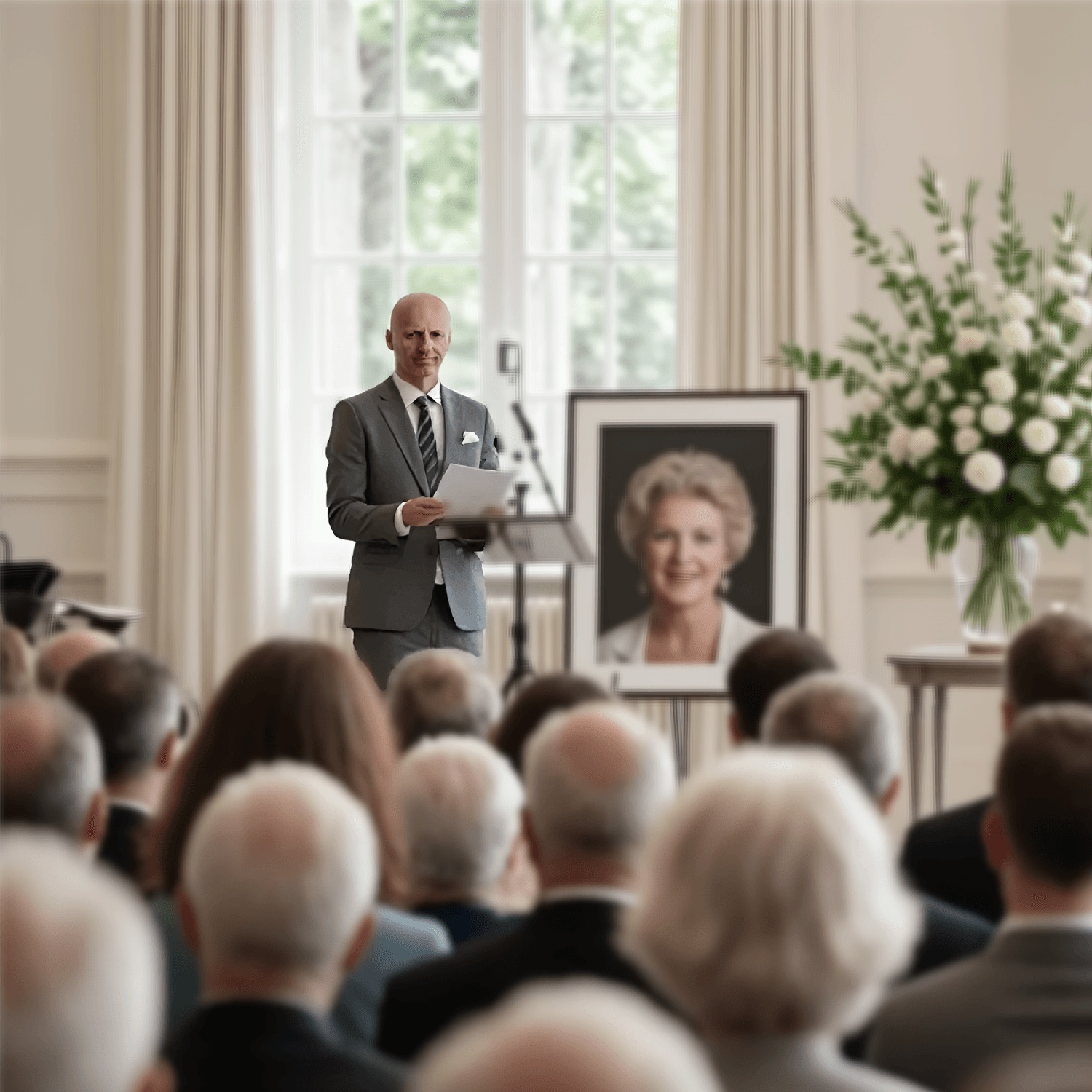
A memorial may follow a funeral on a later date, providing a fuller shared farewell at a time chosen by the family. It may be arranged because relatives or friends were overseas, unwell or otherwise unable to attend the original funeral. Some families choose an anniversary memorial, returning a year later when the first intensity of practical arrangements has passed. It can be an important element of the grieving process for some.
A ceremony can also accompany the scattering of ashes. Where the setting permits it, this may be a quiet gathering outdoors, a woodland farewell or a more formal occasion in a cemetery, memorial garden or private venue. Venue availability, permission, access and practical arrangements should be confirmed with the relevant owner or authority.
Because a memorial is not tied to the same immediate timetable as a funeral, there is often greater freedom over the date, place and length. This can allow time for more people to contribute, for photographs to be gathered, or for a sequence of music, readings and memories to be developed without feeling rushed.
Music, readings, photographs and shared memories
A memorial can hold many voices. Family and friends may share a memory, deliver a reading, choose a piece of music or contribute photographs to a visual tribute. Children or grandchildren may wish to take a simple part. There may be a period of quiet reflection, a prayer or blessing, or a collective act such as placing flowers.
Choice can be helpful, but too many separate items can make an occasion feel fragmented. I help you select and order the contributions so that the ceremony has a natural movement and everyone taking part understands their role.
Planning, writing and presenting the ceremony
We begin with a discovery meeting in which you tell me about the person and what you hope the gathering will offer. I then help establish the structure, gather contributions and write the linking words and, if required, the principal eulogy.
The family reviews the ceremony before it is finalised. On the day, I arrive early, speak with the venue and contributors, welcome guests and lead the occasion. I can deliver the eulogy on the family’s behalf and support anyone who wishes to speak.
If the gathering includes a longer life story, the eulogies and funeral tributes page explains how I gather and shape memories. For religious, spiritual and blended options, see personalised funeral ceremonies.
Memorial service and celebration of life FAQs
What is the difference between a funeral and a memorial service?
A funeral usually takes place soon after death and is connected with burial or cremation. A memorial is held without the coffin present and can take place later, allowing more choice over the date, venue and length.
Can we arrange a memorial after a direct cremation?
Yes. A later memorial can provide the shared farewell that a direct cremation does not include, while giving the family time to plan and allowing more people to attend.
Does a celebration of life have to be informal?
No. It can be relaxed, traditional, reflective or a blend. The phrase describes the focus on the person’s life, not a required style or mood.
Can the ceremony accompany the scattering of ashes?
Yes, where the chosen location permits it. Words, music, readings and personal contributions can be shaped around the scattering itself.
Can family and friends contribute photographs and memories?
Yes. A memorial can include spoken memories, readings, music, photographs or a visual tribute. I help arrange these elements into a ceremony with a clear shape and comfortable pace.
Contact me to discuss your requirements
If it would help to talk things through, you are welcome to call or email me for an initial, no-obligation conversation.